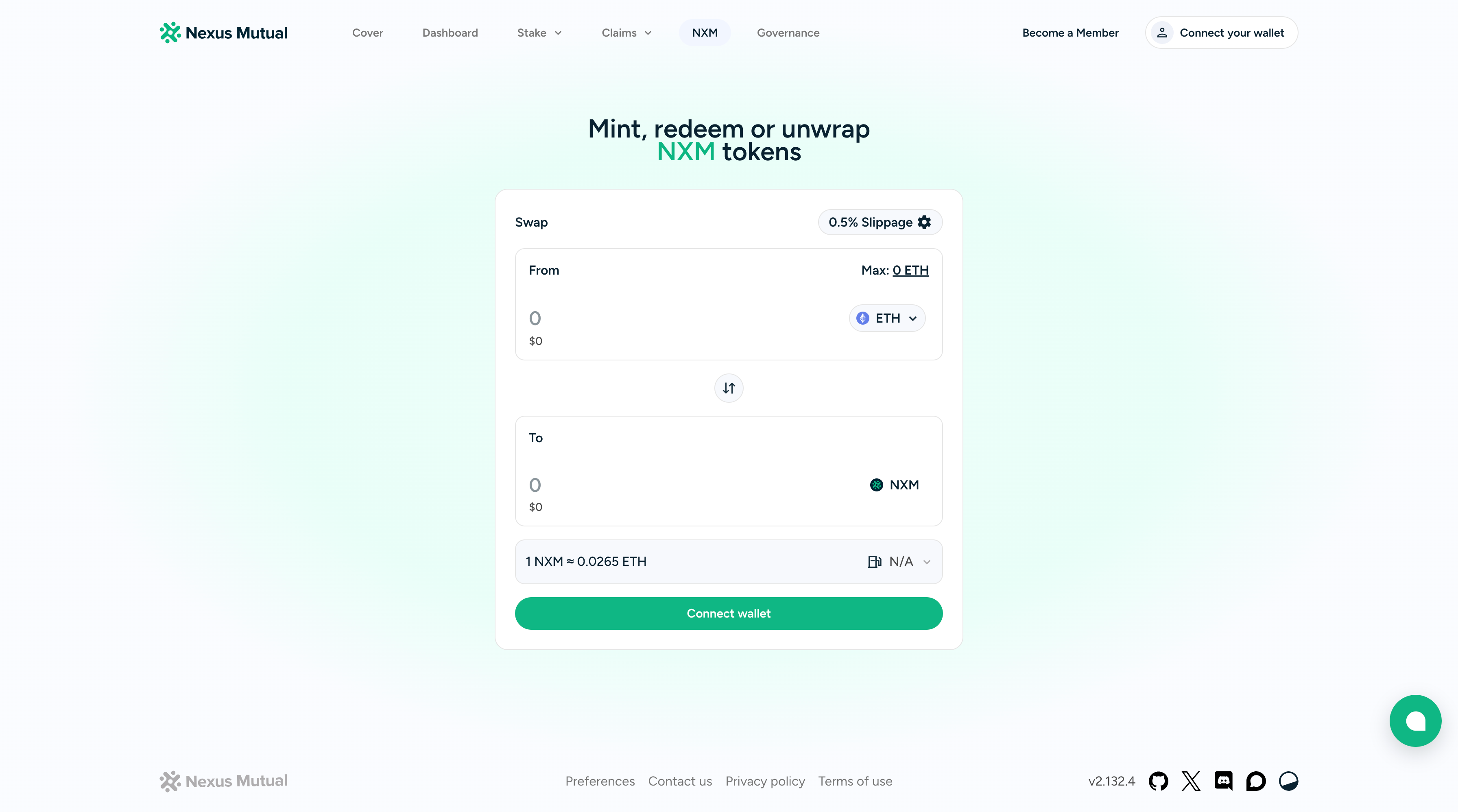
As decentralized finance (DeFi) has grown from niche experiments into multi-billion-dollar markets, so too has the complexity and scale of financial risks in blockchain ecosystems. Smart contract bugs, oracle failures, and governance exploits can wipe out funds in minutes. Traditional insurance models struggle to adapt to code-native risks and the borderless nature of crypto. Nexus Mutual emerged to address this gap by offering a community-governed, risk-sharing protocol that provides cover for smart-contract failure and related losses. Built on Ethereum, Nexus Mutual replaces centralized insurers with a mutual model that leverages on-chain membership, staking, and claims assessment. This article explains what Nexus Mutual is, how it works, its products, governance model, strengths, weaknesses, and broader implications for risk management in Web3.
Nexus Mutual is a decentralized insurance alternative—a mutual—that allows members to share risk by collectively underwriting cover for smart-contract exploits and other blockchain-related failures. Launched in 2019 by a team including Hugh Karp, Nexus Mutual introduces a native membership token called NXM (now often represented as NXM or mnx in some contexts) and a set of functions enabling members to buy cover, stake capital to back policies, and participate in claims assessment and governance. The mutual model means the protocol does not operate as a profit-seeking insurer; instead, capital backing policies is owned by members, and returns or losses accrue to the pool.
Core components and actors
1.Members: Anyone who holds membership in the mutual (typically by purchasing membership through KYC and buying NXM) can buy cover, stake in risk pools, and vote on claims and governance proposals.
2.NXM token: Nexus Mutual’s governance and risk token. The token’s price is algorithmically determined by the mutual’s internal model, which estimates capital adequacy and risk. Holding NXM gives voting rights, and staking NXM as part of underwriting earns rewards but also exposes stakers to losses when claims are paid.
3.Risk Pool / Capital Pool: The mutual holds funds (initially ETH, then diversified) which are used to pay validated claims. Capital providers stake to the pool to back policies; premiums paid by buyers top up capital and compensate stakers.
4.Cover: The product that members purchase to protect an exposure (e.g., a specific smart contract) for a defined period and sum insured. Buyers pay a premium, which depends on the cover amount, duration, and assessed risk.
5.Claims Assessment: A decentralized process where members vote on whether a submitted claim is valid. The outcome determines whether the capital pool pays out.
1.Membership and KYC: To interact fully with Nexus Mutual (especially to become a member and vote), users historically completed KYC/AML steps. Membership is required for participating in claims assessments and other governance activities.
2.Buying cover: A member selects a protocol/certificate to cover (for example, a particular DeFi protocol smart contract) and specifies the desired cover amount and term. The protocol computes premiums based on an internal risk model; paying the premium activates the cover.
3.Backing cover / staking: Other members can stake capital on a cover-writer or in the risk pool. Stakers earn a portion of premiums as rewards proportional to their exposure but accept liability if claims are paid.
4.Incident and claim submission: If a covered protocol suffers a qualifying loss (e.g., a smart contract exploit), the insured member submits a claim with evidence and documentation.
5.Claims assessment and voting: Members assess the claim and vote. For Nexus, voting initially relied on token-weighted votes among assessors and later iterations introduced delegated assessment systems and quorum rules to prevent collusion or apathy.
6.Payout and adjustments: If the claim passes assessment, the capital pool pays out the insured amount (subject to policy terms). Stakers who backed the relevant cover share the loss according to their exposure. Premium income and payouts adjust the mutual’s capital and NXM pricing.
Nexus Mutual’s pricing of cover historically relied on a combination of actuarial inputs, on-chain data, and internal risk models. Because empirical historical datasets in crypto are limited and risks evolve quickly, the mutual blends market-driven pricing with incentives for stakers who perform due diligence. Premiums must be high enough to attract capital and deter moral hazard but competitive for buyers. The mutual also maintains a capital adequacy framework that influences NXM pricing: as risk exposure grows relative to capital, NXM becomes more expensive, thereby incentivizing additional capital inflows or reduced cover demand.
Governance at Nexus Mutual revolves around members and NXM holders. Members vote on claims, system upgrades, and protocol parameters. Over time, Nexus has iterated on governance to become more scalable and resistant to low participation or capture. Key governance challenges include:
Voter apathy and quorum: Ensuring enough informed participants cast votes to make decisions legitimate and timely.
Sybil resistance: Preventing single actors from accumulating outsized voting power or staging fraudulent claims.
Delegation and assessors: Nexus introduced assessor roles, where experienced participants evaluate claims and delegate voting power. This aims to concentrate expertise while preserving decentralization.
While Nexus started by offering cover for smart contract failure, it expanded offerings to include:
Protocol cover for specific DeFi platforms (e.g., lending protocols, DEXs).
Custody and exchange hacks (in some iterations).
Custom covers and parametric products that pay out on predefined measurable events.
The product roadmap emphasized modularity, enabling cover for novel DeFi constructs (e.g., oracles, bridges) as risks evolved.
Aligned incentives: Members who underwrite risk have skin in the game, incentivizing careful due diligence and prudent underwriting.
Community governance: Decisions lie with members rather than centralized underwriters, fostering transparency and community trust.
On-chain settlement: Premiums, staking, and payouts use smart contracts for automated execution and verifiability.
Adapts to Web3 risks: Tailored to smart-contract and protocol-specific failures that traditional insurers find hard to underwrite.
Capital constraints: Early-stage mutuals can be undercapitalized relative to the scale of potential DeFi losses, exposing stakers to large relative losses or leaving claims partially covered.
Pricing and model risk: Accurate pricing in fast-evolving crypto environments is difficult. Mistakes can lead to underpriced risk or unattractive premiums.
Governance vulnerabilities: Low voter turnout, concentrated NXM holdings, or collusion can undermine fair claims assessment.
KYC and decentralization tension: Requiring KYC for full membership clashes with privacy and decentralization ideals; it can limit participation and composability.
Regulatory uncertainty: Insurance often sits within regulated financial services; operating a mutual that resembles insurance products may attract regulatory scrutiny in various jurisdictions.
Correlated systemic risks: DeFi failures can be highly correlated (e.g., cascading liquidations in a market crash), creating tail-risk scenarios that strain pooled capital.
Nexus Mutual has been through real-world tests, including paying out claims after notable hacks and adjusting its protocols over time. These events highlighted several lessons:
Speed and expertise are crucial in claims assessment to prevent gaming and to build trust.
Clear, well-defined policy wording matters; ambiguous terms invite disputes and community friction.
Diversified capital and reinsurance-like mechanisms (e.g., retrocession to other pools or third-party capital) can improve resilience.
Integrating automated on-chain oracles for incident detection can reduce reliance on human reporting and speed up claims processing.
Nexus Mutual has integrated with lending protocols, DeFi dashboards, and user interfaces to make purchasing cover more accessible. Some wallets and platforms allow users to buy cover at the point of interaction with DeFi products, increasing adoption. Strategic partnerships with audits, security firms, and data providers can improve risk assessment and pricing.
Regulatory and compliance considerations
Operating at the intersection of insurance and financial services means Nexus and similar projects must navigate evolving regulatory frameworks. Key considerations:
Licensing: Traditional insurers are regulated and required to hold certain capital and comply with consumer protection laws. Nexus’s mutual model may invoke similar regulatory interest depending on jurisdiction and product structure.
Taxation and reporting: Premiums, payouts, and token economics can create complex tax events for users and the mutual.
Consumer protections: Ensuring transparent terms, dispute resolution mechanisms, and fair treatment is essential to avoid legal risks and reputational damage.
To scale and strengthen decentralized insurance, Nexus Mutual and peers may pursue:
Reinsurance and capital markets integration: Sourcing third-party capital, parametric reinsurance, or tokenized risk tranches to diversify exposure.
Improved risk models and data: Leveraging on-chain analytics, formal verification outputs, and security scoring to refine pricing.
Automated, parametric covers: Offering policies that pay out automatically on verifiable events (e.g., oracle failure thresholds).
Cross-chain coverage: Extending modest to multi-chain deployments and providing cover for bridge and cross-chain risks.
Better UX and embedded insurance: Streamlining purchase flows so users naturally acquire cover when interacting with DeFi.
Nexus Mutual represents an innovative attempt to create decentralized, community-driven insurance tailored to the unique risks of Web3. Its mutual model aligns incentives between buyers and underwriters and leverages on-chain mechanisms for transparency and settlement. However, challenges remain around capital adequacy, governance robustness, precise pricing, and regulatory clarity. As DeFi matures, protocols like Nexus Mutual could play a critical role in making crypto financial systems safer and more credible—provided they evolve their models, expand capital sources, and refine governance to handle increasingly complex and correlated risks. For users and architects of DeFi systems, decentralized insurance is an important piece of the infrastructure that complements audits, formal verification, and secure engineering to build trustworthy ecosystems.
If you’d like, I can:
Produce a sample walkthrough showing how to purchase cover for a specific DeFi protocol on Nexus Mutual.
Compare Nexus Mutual with centralized crypto insurance providers and other decentralized alternatives.
Draft a checklist for assessing the adequacy of DeFi insurance coverage for a given portfolio.

AI Website Builder